Puzzle 13 of 100

Finish the inverter

Goal

Make Y the inverse of A. The top half is drawn: add the N transistor that pulls Y down to GND.

Die
12 by 12 squares
Layers
Metal, Polysilicon, Contact, N active, P active, N well
Input
A
Output
Y
Supply
VDD
Ground
GND

Go to the solution

New in this puzzle

Two switches make an inverter

The P transistor at the top joins Y to VDD while A is low. An N transistor at the bottom joins Y to GND while A is high, so Y is always the opposite of A.

Guide

  1. Extend the polysilicon from A down toward GND, stopping one square above the rail.
  2. Choose N Active and paint five squares across the polysilicon, two rows above the GND rail. Put a contact on each end.
  3. Join the left contact down to GND, and the right contact up to the metal line that leads to Y.

Hint

Extend the polysilicon from A downward, cross it with N active silicon just above the GND rail, and join one side to GND and the other to Y.

Solution

This is the game's reference drawing for the puzzle. It meets the goal and passes the design rules. Other drawings can pass as well.
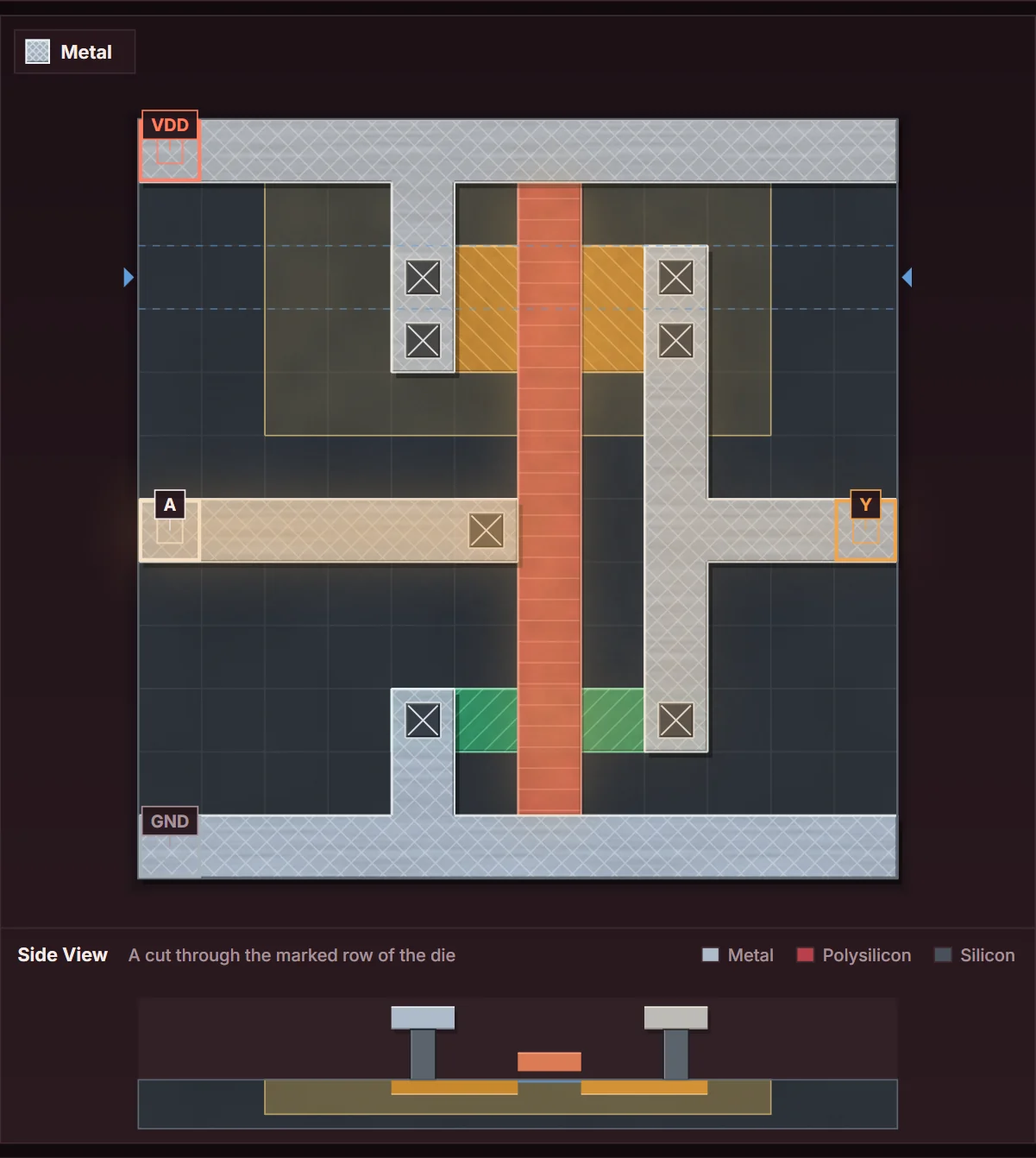
Top View of the solved die for puzzle 13, Finish the inverter, with the Side View below it.
Top View of the solved die, captured from the game. Paths that carry a high level at the moment shown are lit. The Side View below cuts through the row between the dashed lines.
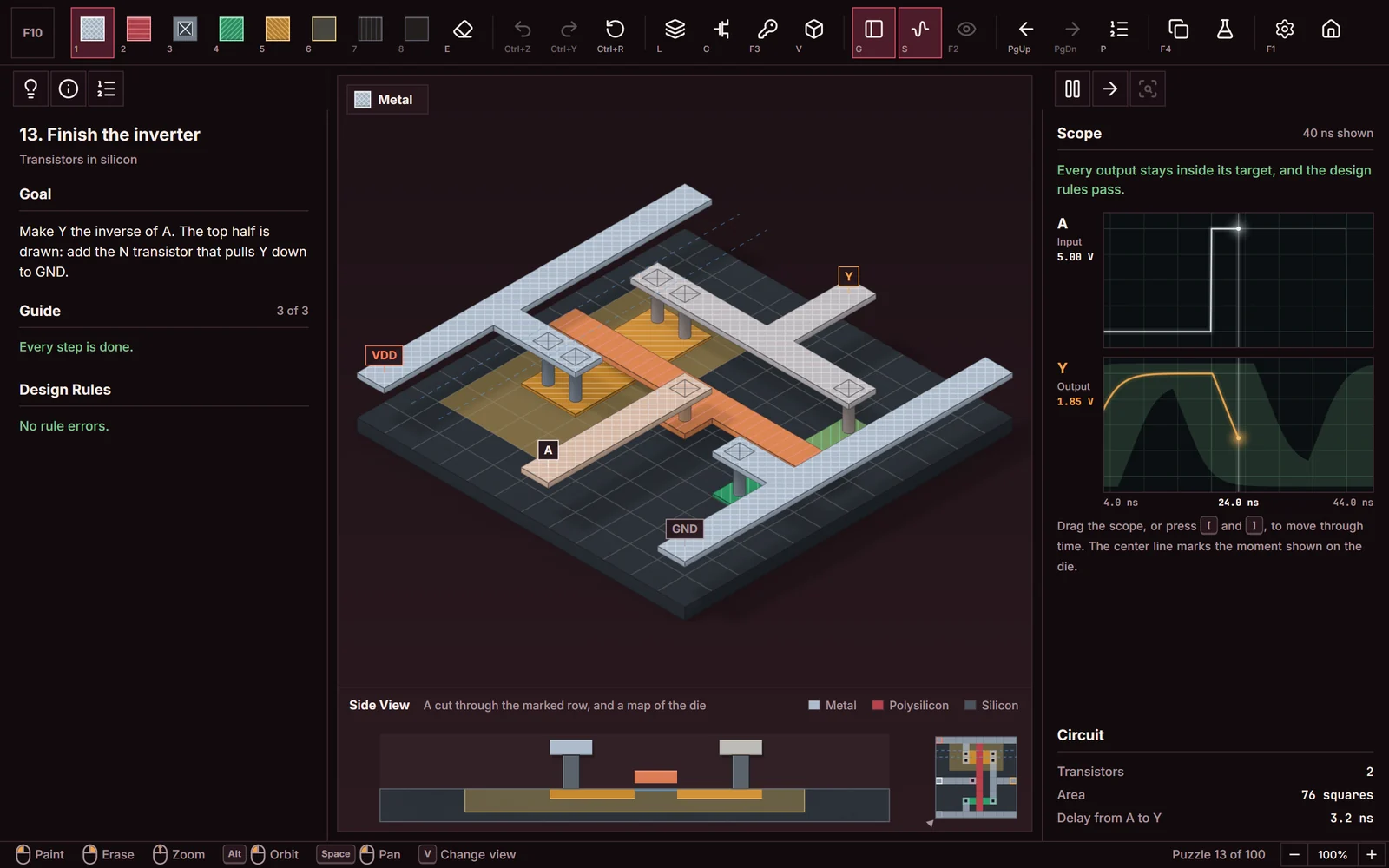
The game window in Isometric View with the solved die for puzzle 13, Finish the inverter, the guide, and the scope.
The whole game window in Isometric View. The scope on the right compares each output with its target band, and the message above it confirms that the drawing passes.
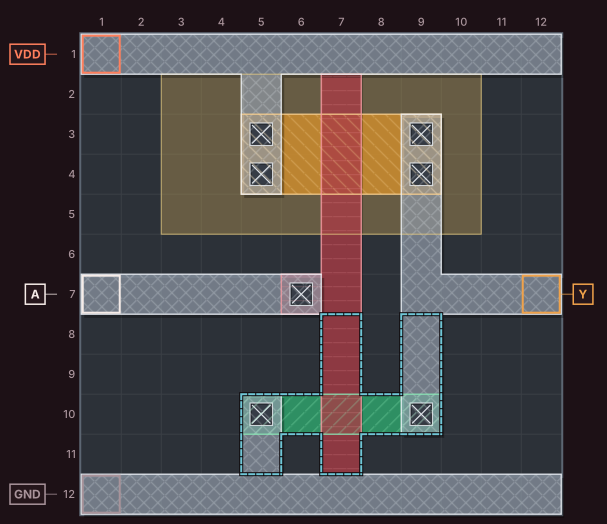
Solution drawing for puzzle 13, Finish the inverter, drawn on a numbered grid with every layer in its game color and pattern.
The solution on the grid. Squares are numbered from the top left corner, so you can count them. The dashed outline marks the squares you draw, change, or erase; the rest is drawn when the puzzle opens.

Legend

  • Metal46 squares
  • Polysilicon11 squares
  • Contact7 squares
  • N active5 squares
  • P active10 squares
  • N well32 squares
  • Input padA
  • Output padY
  • Supply padVDD
  • Ground padGND
  • Squares you draw, change, or erase11 squares

About the drawing

  • The drawing uses 80 of the die's 144 squares.
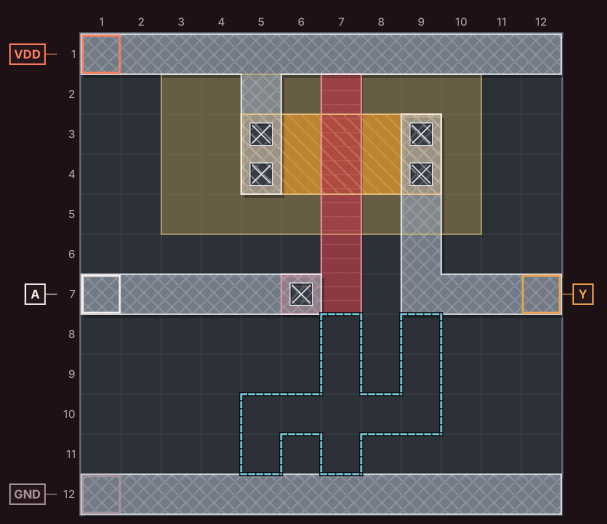
  • Part of the drawing is in place when the puzzle opens. To finish it, paint 11 empty squares.
  • It forms 2 transistors: 1 N transistor and 1 P transistor. Each one is a place where polysilicon crosses active silicon.
  • 7 contacts join metal to the polysilicon or active silicon under it.
Starting drawing for puzzle 13, Finish the inverter, on a numbered grid.
The drawing when the puzzle opens. The dashed outline marks the squares the solution changes.