Puzzle 77 of 100

An edge-triggered flip-flop

Goal

Make Q take the level of D at each rising edge of CLK and keep it until the next rising edge. Changes of D between rising edges do not reach Q.

Die
33 by 14 squares
Layers
Metal, Polysilicon, Contact, N active, P active, N well, Metal 2, Via
Inputs
CLK, D
Output
Q
Supply
VDD
Ground
GND

Go to the solution

New in this puzzle

Two latches

Two latches in a row that open on opposite levels of the clock are never open together. The first takes D while CLK is low, and the second passes it on when CLK rises, so the output changes only at a rising edge.

Hint

The first latch is open while CLK is low. Add the switch of the second latch so that it is open while CLK is high: its P transistor takes the inverse of CLK from the lower track, and its N transistor takes CLK from the upper track.

Solution

This is the game's reference drawing for the puzzle. It meets the goal and passes the design rules. Other drawings can pass as well.
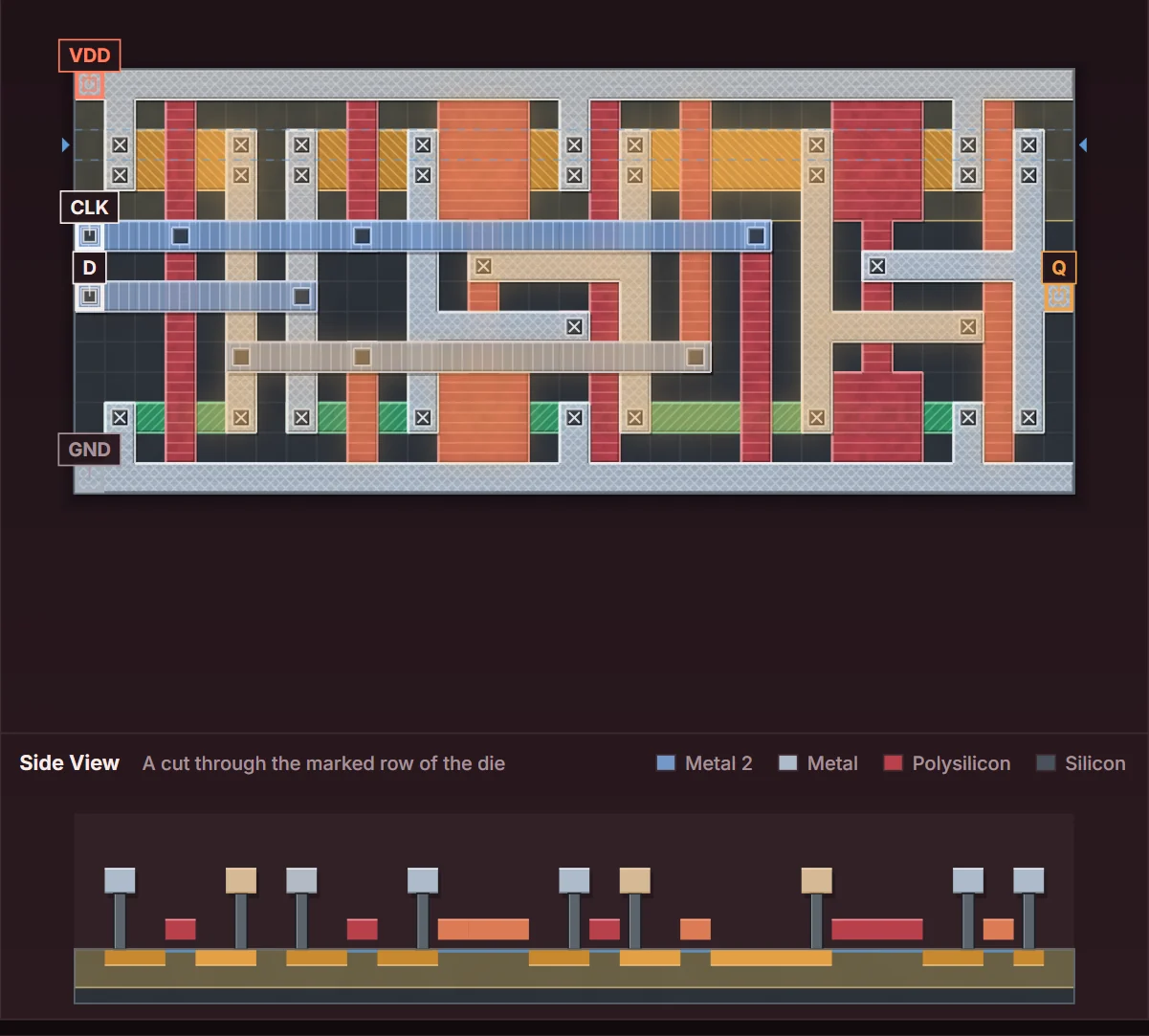
Top View of the solved die for puzzle 77, An edge-triggered flip-flop, with the Side View below it.
Top View of the solved die, captured from the game. Paths that carry a high level at the moment shown are lit. The Side View below cuts through the row between the dashed lines.
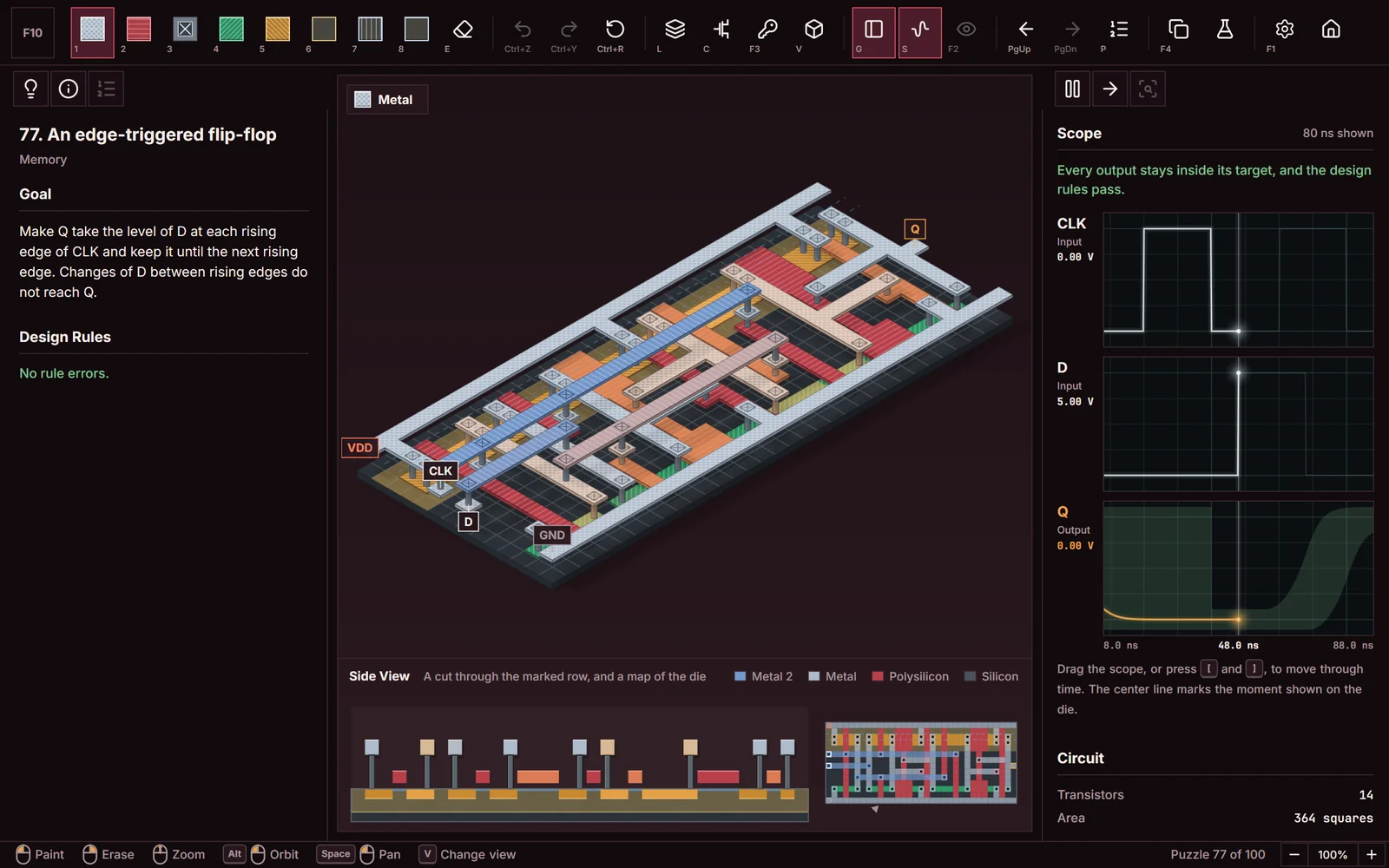
The game window in Isometric View with the solved die for puzzle 77, An edge-triggered flip-flop, the guide, and the scope.
The whole game window in Isometric View. The scope on the right compares each output with its target band, and the message above it confirms that the drawing passes.
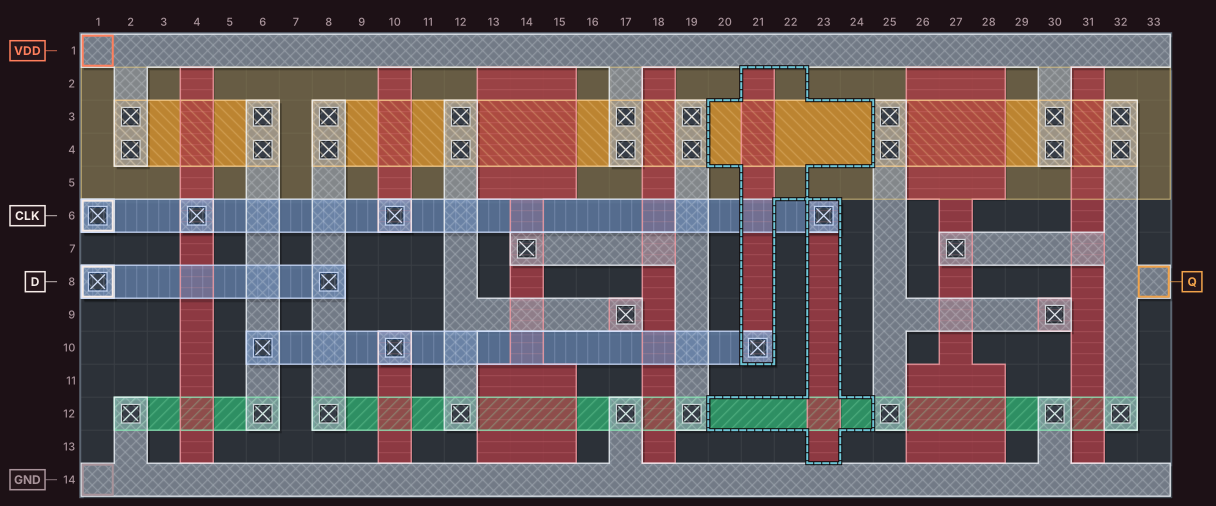
Solution drawing for puzzle 77, An edge-triggered flip-flop, drawn on a numbered grid with every layer in its game color and pattern.
The solution on the grid. Squares are numbered from the top left corner, so you can count them. The dashed outline marks the squares you draw, change, or erase; the rest is drawn when the puzzle opens.

Legend

  • Metal169 squares
  • Polysilicon116 squares
  • Contact36 squares
  • N active30 squares
  • P active60 squares
  • N well132 squares
  • Metal 247 squares
  • Via9 squares
  • Input padCLK, D
  • Output padQ
  • Supply padVDD
  • Ground padGND
  • Squares you draw, change, or erase31 squares

About the drawing

  • The drawing uses 367 of the die's 462 squares.
  • Part of the drawing is in place when the puzzle opens. To finish it, paint 18 empty squares and change 13 drawn squares.
  • It forms 14 transistors: 7 N transistors and 7 P transistors. Each one is a place where polysilicon crosses active silicon.
  • 36 contacts join metal to the polysilicon or active silicon under it.
  • 9 vias join metal 2 to the metal under it.
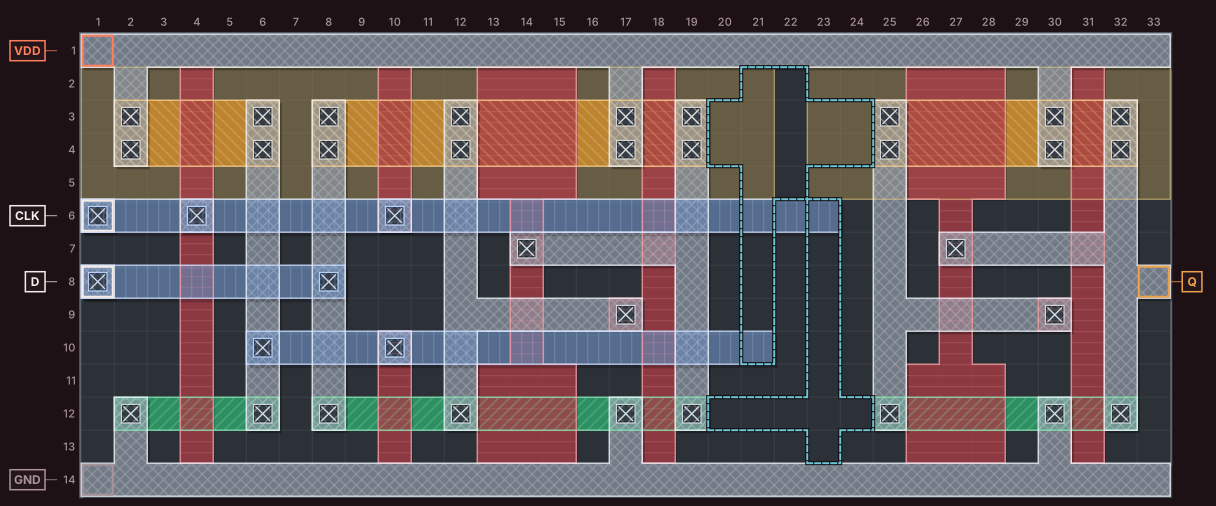
Starting drawing for puzzle 77, An edge-triggered flip-flop, on a numbered grid.
The drawing when the puzzle opens. The dashed outline marks the squares the solution changes.